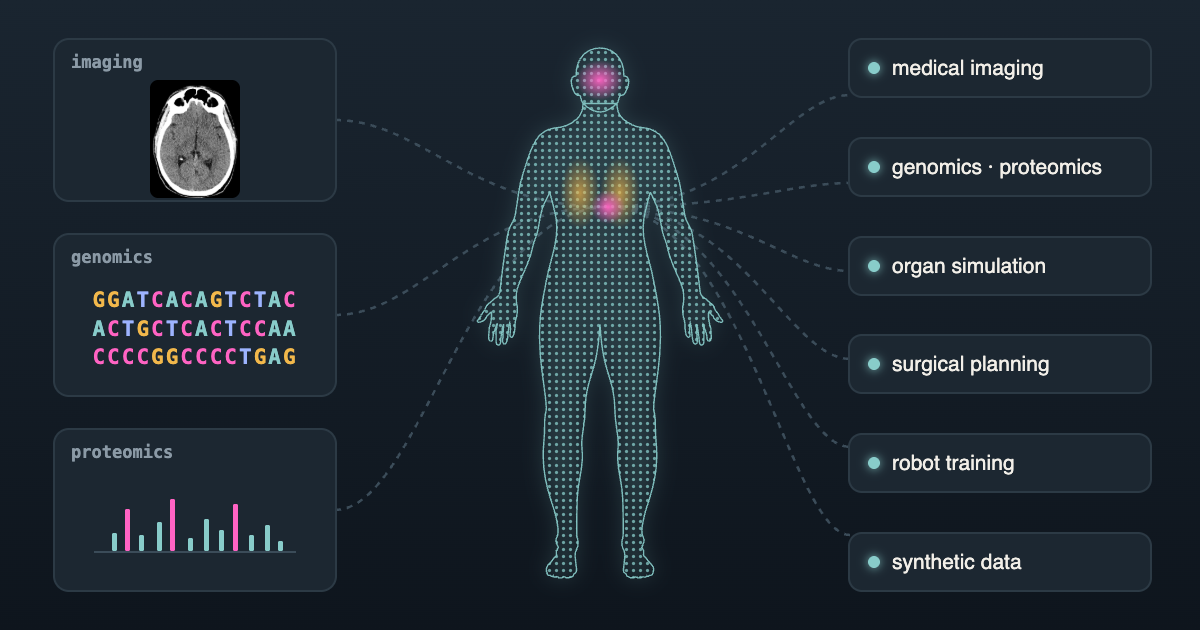
Medicine still learns mostly from real patients. Every new drug, device, surgical plan or AI model is tested on people, or on data collected from them one modality at a time: imaging shows anatomy, sequencing shows the genome, proteomics shows molecular state, and no single model ties them together into a patient we can safely run experiments on. This project asks how to build digital twins: computational models of a patient's organs and biology that can be simulated, queried and perturbed in place of the real person. Four questions guide it:
- How can imaging, genomics and proteomics be fused into one model that stays consistent from molecules to cells to organs?
- Can a twin built from a patient's own scans predict how an organ responds to a drug, a device or a surgical intervention?
- Can a twin generate realistic, labelled synthetic data to train medical AI and surgical robots without exposing patient records?
- How do we validate a twin against the real patient, so a clinician knows when its predictions can be trusted?
Our final goal is Virtual Humans: digital twins of the whole patient that can serve any task in healthcare, from imaging and multimodal genomics and proteomics to organ studies, surgical planning, training robotic models and generating synthetic data.