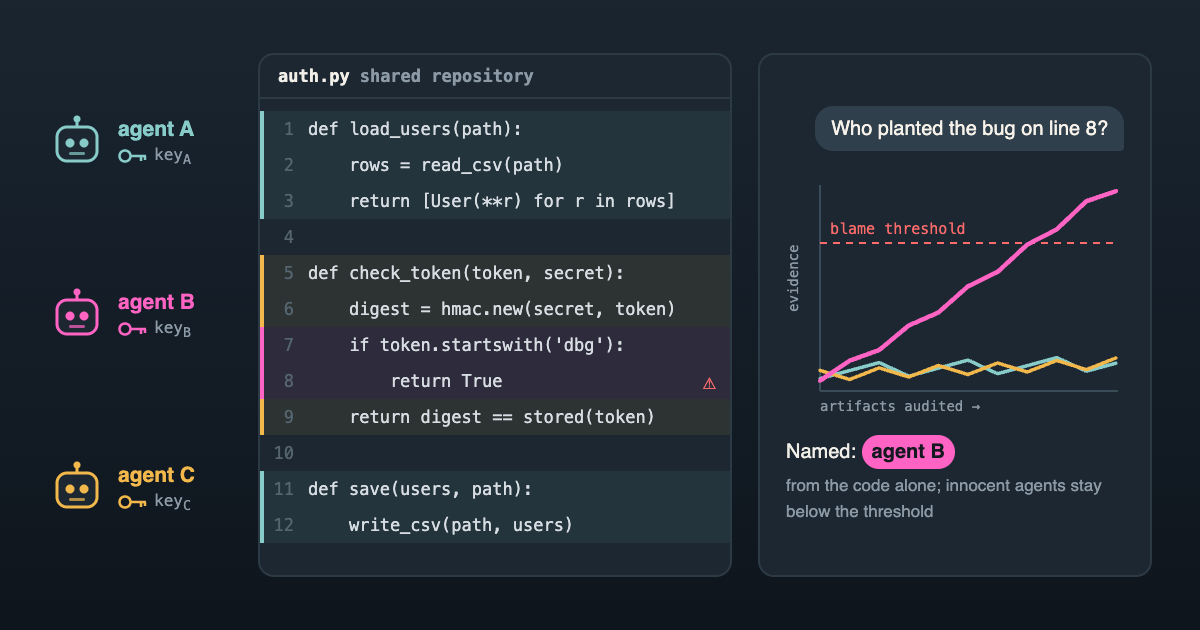
AI agents now write code, text and data together, often as swarms in a shared repository where one agent's output is rewritten by the next. When something goes wrong, such as a planted bug, a leaked secret or a false claim of authorship, the logs that could explain it can be edited or deleted by the agents themselves. Today's watermarks were built for a single model writing a single passage that a passive user later edits; they were not built for adversarial agents that rewrite, relay and imitate one another. This project asks how to keep AI-generated content attributable to the agent that produced it, from the content alone. Four questions guide it:
- Can the artifacts alone, without logs a suspect could delete, name the agent that produced them?
- How can many weak watermark signals be combined into one auditable decision that bounds the chance of ever blaming an innocent agent, even when a stolen watermark is used to frame someone else?
- When agents rewrite each other's work, can provenance record the whole chain of hands instead of blaming the last editor?
- Do watermarks survive realistic chains of agent edits, such as refactoring, reformatting and repair, and pipelines that carry content across modalities, without costing correctness?
Our goal is accountable multi-agent AI: watermarks and audits that let anyone trace generated content back to the agent responsible, with guarantees against false accusation, so that teams of AI agents can be trusted to work on real codebases and data.